Retrace Filter ZigZag
Confirms a reversal from highs and lows compared with the previous bar and the retracement relative to the previous leg. Arrows are shown on the bar where confirmation was judged, at the candidate price, not on the past bar of the high or low.
Coming soon · MT5 only · no licence file needed
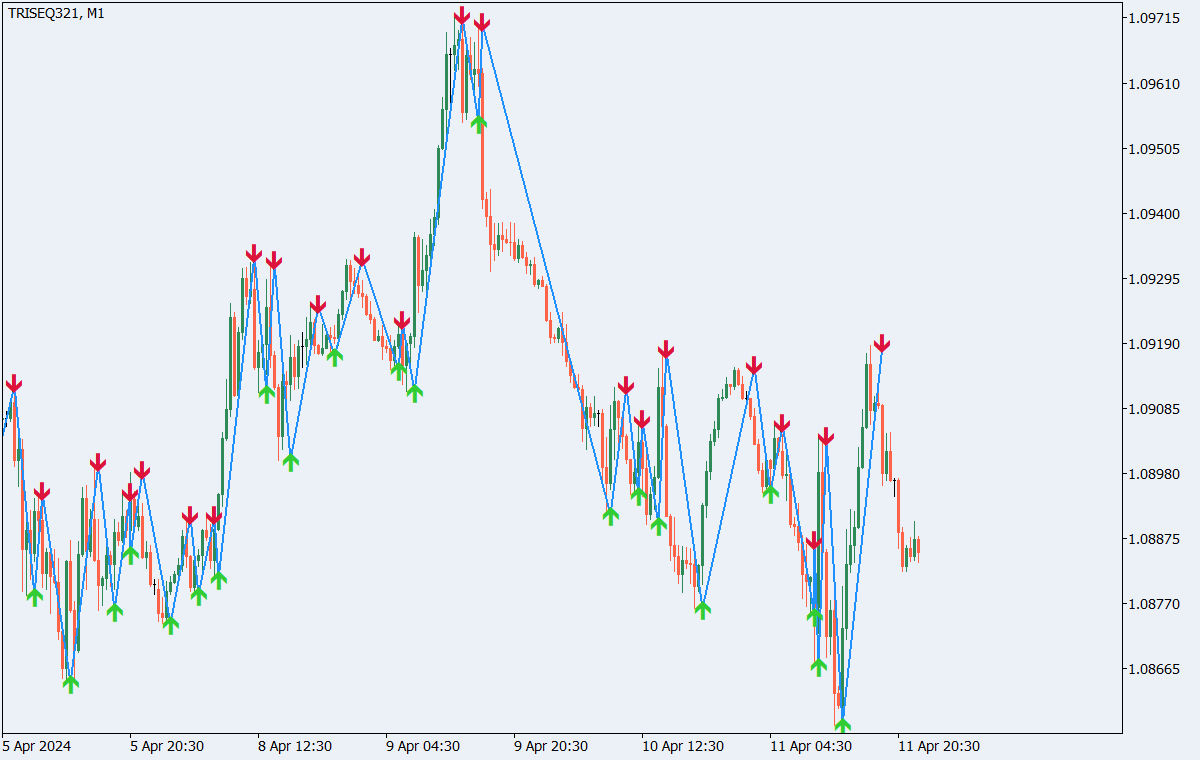
Examples with changed settings are in the manual.
Main settings
| Input | Default |
|---|---|
| Bars (1 to 10) | 2 |
| Minimum Retracement (0 to 0.9 of the previous leg) | 0.22 |
| Show New Highs And Lows | false |
| Closed Bars Only | true |
| Show Trilogy brand and QR code | true |
| Brand position (chart corner) | Lower left |
| Brand horizontal offset (pixels) | 10 |
| Brand vertical offset (pixels) | 10 |
Usage specifications
Dots after confirmation and new lines
When closed bars are added in sequence with the same history and settings, confirmed dots are not moved into the past. However, when a new vertex forms, a connecting line is added.
Scope of recalculation
Recalculation occurs on input changes, additional loading or correction of history, and changes of the calculation start position. In these cases, the past display is not guaranteed to stay unchanged.
Setting that includes the forming bar
With Closed Bars Only false, the display on the latest bar is provisional. Distinguish recalculation that follows price updates on the same bar from confirmation on a closed bar.
Difference from other methods
The mechanism differs from zigzags that later delete or move past vertices. Even if settings with similar names are entered, the prices, times and number of vertices do not necessarily match.
For on-screen display only
The display is a record of calculation results. It does not direct trading decisions and does not guarantee future price movements.
Full manual
How to read the display, the settings, installation and what to check when something goes wrong, on one page. The product is in preparation for release; the manual is published so that you can review its content.
- MT5 display and examples of changed settings
- How to read it in 30 seconds
- What it measures
- Situations for reading the display
- Steps for checking the display
- Installation and checking the package contents
- Settings
- Usage specifications
- Troubleshooting and usage notes
- Technical information and specification details