DI Cross Arrows
Shows up or down arrows on bars where the order of +DI and −DI switches.
Coming soon · MT5 only · no licence file needed
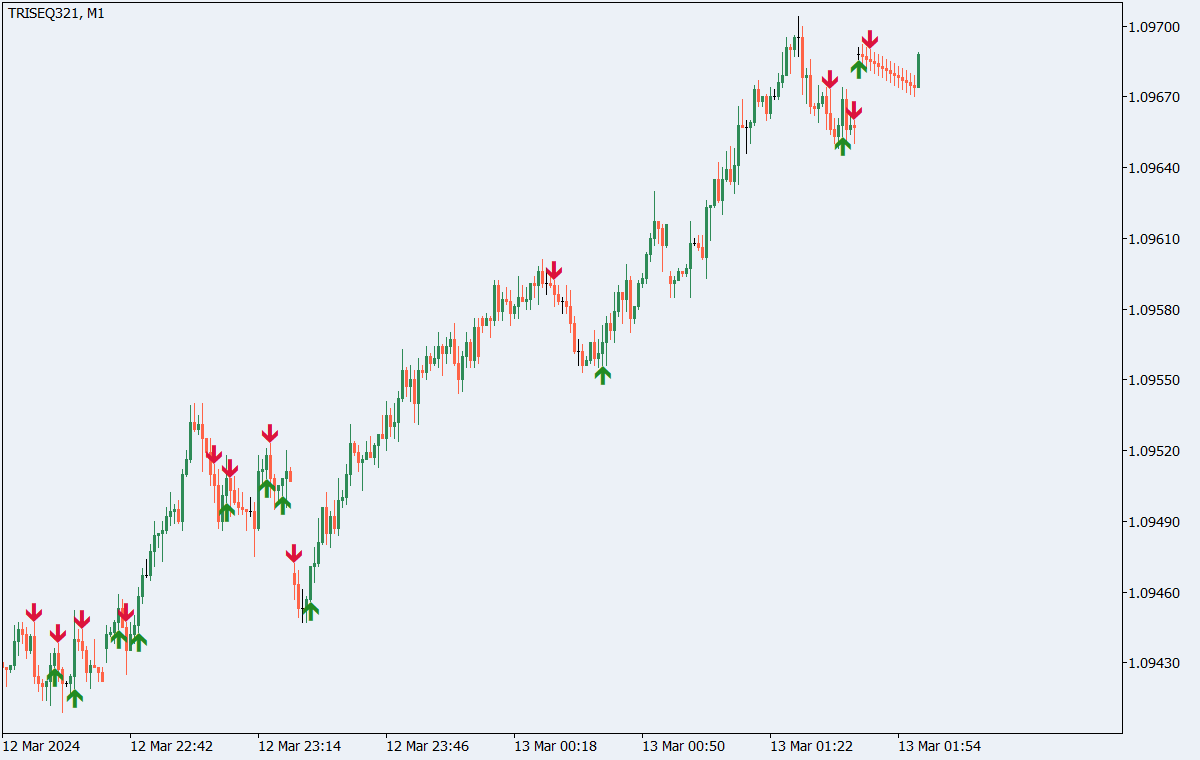
Examples with changed settings are in the manual.
Main settings
| Input | Default |
|---|---|
| DI Period | 14 |
| DI Type | Standard |
| Closed Bars Only | true |
| Arrow Gap (pixels) | 8 |
| Alert on Closed-Bar Cross | false |
Usage specifications
Start of notifications
Right after attaching or reinitializing, past switches are not notified. After that, it notifies only when a switch occurs on a new latest closed bar.
Notification target
Even when several bars advance at once, it looks only at the 1 latest closed bar. There is no email or push sending function.
History and initial display
The initial section up to period n and the first direction are not treated as switches. Marks appear only after both the required history and the switch condition are met.
Redrawing
It is recalculated on the forming bar, on history updates and on settings changes. Permanent non-repainting is not guaranteed.
Only 1 instance of the same product on 1 chart
This manual describes adding 1 instance of this product to 1 chart. To compare different settings, use separate charts.
For on-screen display only
This product shows calculation results through plot buffers and does not place trade orders. It does not guarantee profit or future price movement.
Full manual
How to read the display, the settings, installation and what to check when something goes wrong, on one page. The product is in preparation for release; the manual is published so that you can review its content.
- MT5 display and examples of changed settings
- How to read it in 30 seconds
- What it measures
- Situations for reading the display
- Steps for checking the display
- Installation and checking the package contents
- Settings
- Usage specifications
- Troubleshooting and usage notes
- Technical information and specification details