Day Anchored MA
A moving average whose period grows as bars accumulate during the day and returns to 1 when the day changes.
Coming soon · MT5 only · no licence file needed
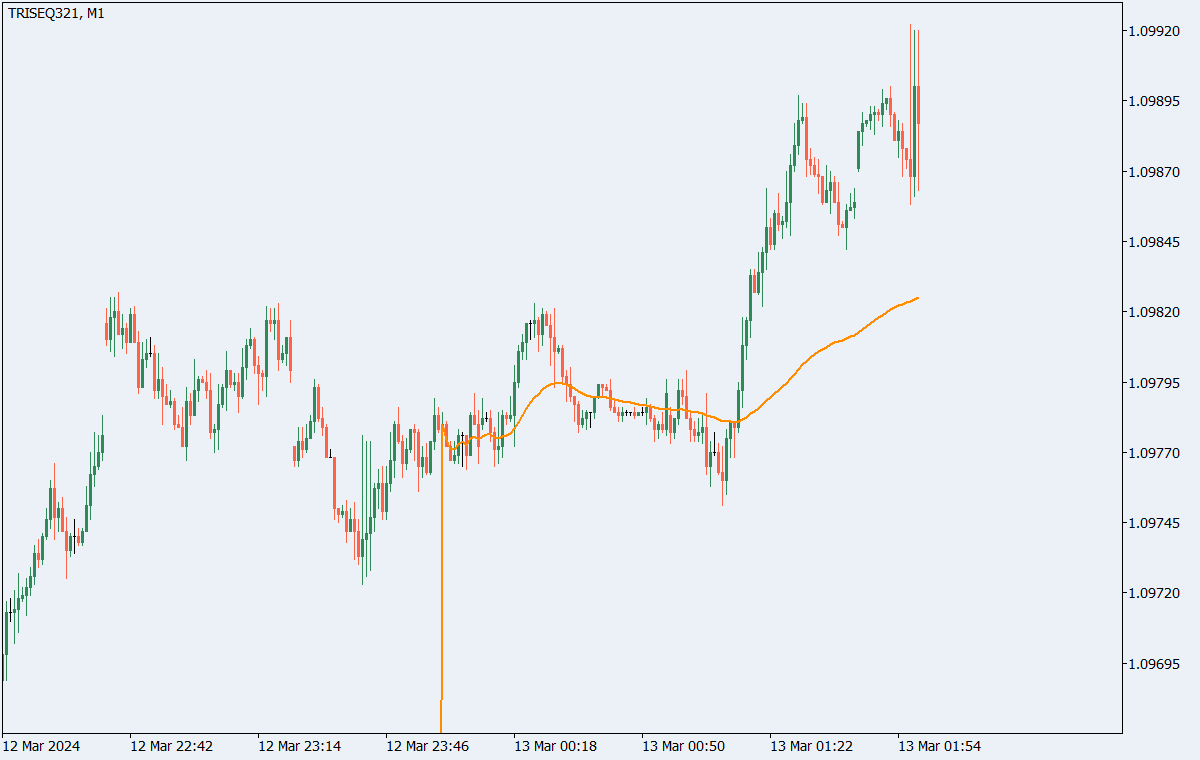
Examples with changed settings are in the manual.
Main settings
| Input | Default |
|---|---|
| MA Method | EMA |
| Applied Price | CLOSE |
Usage specifications
For short MT5 timeframes
Use it on timeframes shorter than daily. If the timeframe changes, the number of bars in 1 day also changes, so the line values are not the same.
Forming bar
When the price of the latest bar changes, the line value also changes. The calculation does not use future bars.
Calculation on long history
Because EMA calculates several periods, the initial calculation may be heavy, especially on long history with short timeframes. The time until display is not guaranteed.
Shows only a line
1 DarkOrange line. There are no arrows, notifications, sounds or trading signals. The color does not change with the state of the value.
Only 1 instance of the same product on 1 chart
This manual describes adding 1 instance of this product to 1 chart. To compare different settings, use separate charts.
For on-screen display only
The display is a record of calculation results. It does not direct trading decisions and does not guarantee future price movements.
Full manual
How to read the display, the settings, installation and what to check when something goes wrong, on one page. The product is in preparation for release; the manual is published so that you can review its content.
- MT5 display and examples of changed settings
- How to read it in 30 seconds
- What it measures
- Situations for reading the display
- Steps for checking the display
- Installation and checking the package contents
- Settings
- Usage specifications
- Troubleshooting and usage notes
- Technical information and specification details