Adaptive MA Step
Overlays on a blue adaptive moving average (AMA) an orange step line that holds back small one-bar changes. It compares the change of the AMA, not the distance between price and the step line.
Coming soon · MT5 only · no licence file needed
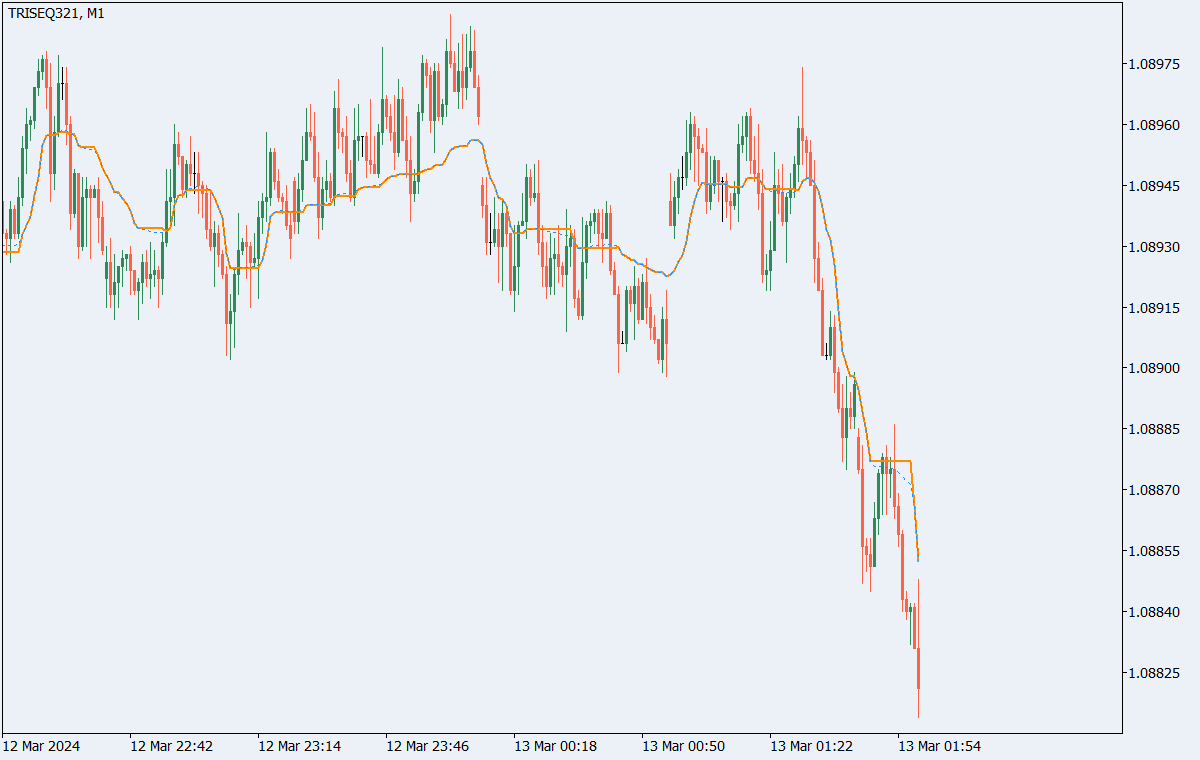
Examples with changed settings are in the manual.
Main settings
| Input | Default |
|---|---|
| Efficiency Period | 10 |
| Fast Period | 2 |
| Slow Period | 30 |
| Smoothing Power | 2 |
| Applied Price | Close |
| Step Filter (%) | 50 |
| Filter Bars | 30 |
| Show AMA | true |
Usage specifications
Required history
AMA starts from bar n+3 counted from the oldest, and the steps from bar n+W+2. The defaults are the 13th and 42nd bars. In the changed example they are the 163rd and 262nd bars, so with 200 bars of history only AMA appears.
Latest bar and history
The latest line changes with the price. It is recalculated when the start or content of the history, or the settings, change.
With a 1-bar average
With Filter Bars=1 and Filter Percent of 100 or less, the steps have the same value as AMA.
Only 1 instance of the same product on 1 chart
This manual describes adding 1 instance of this product to 1 chart. To compare different settings, use separate charts.
For on-screen display only
This product shows calculation results through plot buffers and does not place trade orders. It does not guarantee profit or future price movement.
Full manual
How to read the display, the settings, installation and what to check when something goes wrong, on one page. The product is in preparation for release; the manual is published so that you can review its content.
- MT5 display and examples of changed settings
- How to read it in 30 seconds
- What it measures
- Situations for reading the display
- Steps for checking the display
- Installation and checking the package contents
- Settings
- Usage specifications
- Troubleshooting and usage notes
- Technical information and specification details